Alpharetta is the biggest name in North Atlanta real estate, and the one buyers arrive with the strongest opinions about — usually formed from a weekend at Avalon.
This is the longer answer: what it is like to actually live here, how the schools work, which neighborhoods suit which buyers, and the address problem that is the mirror image of the one next door in Johns Creek.
Start with that, because it decides which city you are buying in.
An Alpharetta mailing address does not mean you are in Alpharetta. The city uses four ZIP codes — 30004, 30005, 30009 and 30022 — and 30004 in particular is a wide net. The City of Milton has no post office of its own, so most Milton mail is processed through the Alpharetta facility on Old Milton Parkway and most Milton homes carry an Alpharetta, GA 30004 address. Parts of Forsyth and Cherokee counties fall under 30004 as well.
So "Alpharetta, GA" on a listing can mean the City of Alpharetta, the City of Milton, or unincorporated county. Those are different city governments, different city services, different city tax bills — and frequently a different high school. Ask which city a house is actually in before you get attached to it. It is a thirty-second question that changes the answer to several others.
This is the opposite of the Johns Creek problem, where the city has no ZIP of its own and its homes get filed under everyone else's name. Here, Alpharetta's name gets applied to everyone else's homes. Same lesson from both directions: in North Atlanta the address is the least reliable thing on a listing.
The city is older than it looks. Alpharetta was incorporated in 1858 and was the county seat of Milton County until 1931, when Milton County merged into Fulton to avoid bankruptcy during the Depression. The name survives all over the map — Old Milton Parkway, Milton High School, and the City of Milton, which incorporated in its own right in 2006. Almost none of that is visible from Avalon, but it explains a lot of the local geography.
It is also a place people work, not only sleep. Alpharetta has been laying optical fiber since the 1980s and hosts a real cluster of data centers, fintech and corporate offices — ADP, Morgan Stanley and AT&T all employ thousands here. That matters for buyers in a practical way: a meaningful share of the people who live in Alpharetta also work in Alpharetta, and a commute measured in minutes rather than a run down GA 400 is a genuine option here in a way it is not in most of the metro.
The public space got the same investment as the fiber. There are more than twenty-five parks covering over 775 acres. Wills Park is the biggest at 120 acres, with an equestrian center, disc golf, a community garden and three playgrounds. Webb Bridge Park covers 109 acres with fields, a lake and an arboretum. North Park has 97 acres. The Big Creek Greenway runs about nine miles of paved trail with trailheads at Rock Mill, Union Hill, Northpoint, Haynes Bridge and several others. And Ameris Bank Amphitheatre at Encore Park has been the area's outdoor concert venue since 2008 — the Atlanta Symphony Orchestra played its opening night and still returns.
Two downtowns is the short version of the rest. Avalon opened as an 86-acre mixed-use district with roughly 570,000 square feet of retail, more than 600,000 square feet of office, over 600 residences, a hotel and a cinema. Then the city rebuilt its actual downtown: City Center, a $130 million project across 26 acres and six blocks, finished in 2019, with about 25 shops and a dozen restaurants — deliberately no national chains — woven into the historic storefronts so it is hard to tell the new from the old. The Alpha Loop, a paved one-mile trail, connects the two.
That combination is why Alpharetta commands the premium it does in North Fulton, and it is the honest answer to why the same house costs more here than one exit away.
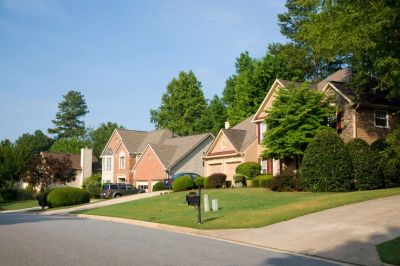
Alpharetta covers about twenty-seven square miles and the character changes a lot inside it.
Windward. The one everybody names first, and it is enormous — over 3,400 acres holding more than forty separate gated enclaves. The 200-acre Lake Windward is residents-only. The Golf Club of Georgia runs two championship eighteens and a clubhouse over 20,000 square feet, and there are twenty lighted tennis courts across clay and hard surfaces. It is less a subdivision than a small town with a gate, and it suits buyers who want the amenities on site rather than down the road.
The Manor Golf and Country Club. Top of the market, gated, golf, large architecturally ambitious homes. Technically a Milton address for much of it — see the section above.
White Columns and Crooked Creek. Both gated country-club communities on the Milton side of the line. Crooked Creek covers about 500 acres and dates to 1993, and both are established rather than new, with mature trees and long-tenured neighbors.
Country Club of the South. Carries an Alpharetta address and sits in Johns Creek. A clean example of why the mailing address is not the city.
Downtown and Avalon-adjacent. Foundry sits across from Avalon and mixes single-family homes with townhomes; Atley and similar developments put condo flats and two- and three-story townhomes within walking distance of downtown. This is the fastest-growing corner of Alpharetta's demand, and it suits people who want to walk to dinner — which, in suburban Atlanta, is genuinely rare.
Established swim-and-tennis neighborhoods. The broad middle of the market and where most Alpharetta families actually land — 1990s and 2000s construction, four bedrooms, a cul-de-sac, a pool and a swim team. Deer Lake, Academy Park, Dunmoor and dozens more. Widest selection and the widest range of condition.
What each of these costs moves with the market, and any number we printed here would be wrong within a year. Tell us your budget and we will tell you exactly what it buys in Alpharetta this month.
Alpharetta is served by Fulton County Schools, the same district as Johns Creek, and the schools are a primary reason buyers choose North Fulton at all.
The high schools that serve Alpharetta addresses are Alpharetta, Milton, Cambridge and — for some southern addresses — Chattahoochee. Cambridge opened in August 2012 specifically to relieve overcrowding at Alpharetta High and Milton High, and it sits physically in Milton while drawing from both. Middle schools in the Alpharetta High cluster include Webb Bridge and Hopewell; elementary schools include Creek View, Lake Windward, Manning Oaks and New Prospect.
There is also Innovation Academy, a Fulton County STEM magnet high school on Milton Avenue in Alpharetta that opened in 2021 with healthcare, IT and engineering pathways. It is application-based, not zoned, so a house does not get you in — worth knowing if a family is counting on it.
Now the part that costs people money here. Because so many Milton homes carry an Alpharetta 30004 address, you cannot read the high school off the mailing address. Two houses a few minutes apart, both saying Alpharetta, can feed Alpharetta High, Milton High or Cambridge. And a boundary that has already been redrawn once to open a new school can be redrawn again.
Verify the attendance zone against the specific street address before you write an offer, and ask whether the area is under discussion for rezoning. We check both on every Alpharetta home we show.
Where is it, exactly? North Fulton County along the GA 400 corridor, about 25 miles north of downtown Atlanta, bordered by Milton to the north, Roswell to the south and west, Johns Creek to the southeast, and Forsyth County to the northeast.
Alpharetta or Johns Creek? The question we get most. Alpharetta has Avalon, a rebuilt downtown, the Alpha Loop and the nightlife; Johns Creek is quieter and generally gets you more house for the money. Both are Fulton County Schools. If walkable dining and things to do on a Friday night are worth paying for, Alpharetta. If square footage and a quiet street matter more, look at Johns Creek first.
Alpharetta or Milton? Often the same house, and the choice is more about services and schools than about lifestyle. Milton is more rural in feel — larger lots, horse fences, a deliberate low-density policy — while the City of Alpharetta is denser and more amenity-rich. Confirm which one you are actually buying in.
Is it walkable? Parts of it genuinely are, which sets it apart from most of North Atlanta. Downtown, Avalon and the Alpha Loop that links them are real walkable districts. The subdivisions are not — you will still drive most days.
Is it expensive? Yes, relative to the Gwinnett and Forsyth markets nearby, and the premium is not imaginary — you are paying for the school districts, the two downtowns and, for a lot of buyers, a short commute to a job in the same city.
If you're thinking about moving here, come on a weekday and again on a Saturday evening. Alpharetta on a Tuesday morning and Alpharetta at Avalon on a Saturday night are two different places, and you should like both before you commit.
If you're thinking about selling, know that Alpharetta buyers are comparison shoppers with a lot of inventory to compare against, including new construction. They will know your school zone, your comps and your days on market. Pricing accuracy and condition carry the day here.
Want to know what your Alpharetta home is worth? We will pull the comps and send you a real opinion on price within one business day — with the reasoning, so you can judge it yourself. Start at hamiltonhomegroup.com/home-value.
Thinking about buying here? Tell us what you are looking for and we will tell you honestly whether it exists in your budget. Reach us at hamiltonhomegroup.com/contact.
For current market numbers, our weekly market updates are at hamiltonhomegroup.com/blog.
We use cookies to analyze website traffic and optimize your website experience. By accepting our use of cookies, your data will be aggregated with all other user data.